The 8 O'Clock Ritual: How Princeton Households Are Bringing Back the Art of Watching Together
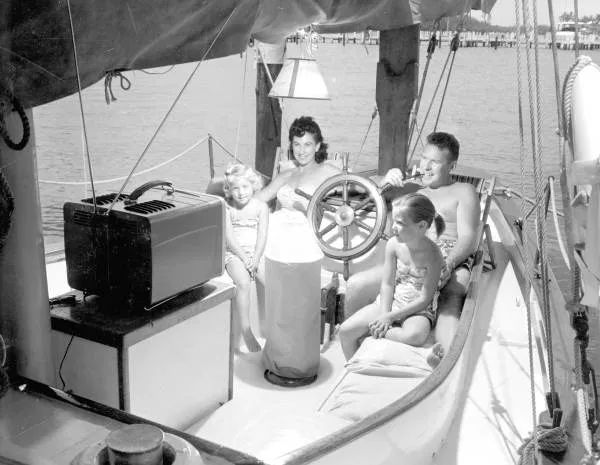
Photo: Florida Memory, No restrictions, via Wikimedia Commons
There is a particular quality to the silence that settles over the Harrington household at seven fifty-five on a Thursday evening. The phones are face-down on the kitchen counter. The laptop is closed. The younger children have finished their homework, and the older ones have, somewhat grudgingly, agreed to be present. By eight o'clock, all five members of the family are seated in the living room, watching the opening credits of a locally produced documentary series air on their community television channel.
"We started doing this about a year ago," says Ellen Harrington, a Princeton resident of twelve years. "It felt a little forced at first, honestly. But now it's just — it's Thursday. That's what Thursday is."
The Harrington family is not an anomaly. Across Princeton, a growing number of households are voluntarily structuring their evenings around scheduled community television programming, deliberately opting out of the frictionless, algorithm-driven viewing habits that have come to define American leisure time. The trend is modest in scale but striking in what it reveals about a deepening hunger for shared, synchronous experience.
What Appointment Viewing Once Meant
To understand what is being reclaimed, it helps to recall what was lost. For most of the twentieth century, watching television was an inherently communal act. Broadcast schedules imposed a shared temporal framework on audiences who had no practical alternative. Families gathered not because they had consciously chosen togetherness but because the medium itself demanded it. You watched when the program aired, or you did not watch at all.
The cultural rituals that grew up around this constraint — the weekly family viewing night, the neighborhood conversation the following morning, the collective anticipation of a season finale — were, in retrospect, a form of social infrastructure. They created shared reference points, synchronized emotional experiences, and a sense of participation in something larger than the individual household.
Streaming dismantled much of that infrastructure with breathtaking efficiency. When every episode of every series became available at any moment, the appointment dissolved. Viewing became private, asynchronous, and deeply personalized. The algorithm learned what each individual wanted and delivered it with frictionless precision — optimizing for engagement at the expense of the shared experience that once gave television its communal dimension.
The Local Difference
What makes the Princeton community television revival distinct from a simple nostalgia exercise is the nature of the programming around which families are choosing to gather. This is not a case of households scheduling time to watch network reruns or classic films. The programs drawing these deliberate audiences are hyperlocal productions: documentary portraits of Princeton institutions, coverage of township meetings, profiles of long-time residents, cultural programming produced by community members for community members.
The local specificity of the content appears to be central to its appeal. When a program features a school that your children attend, a neighborhood you walk through daily, or a community leader you recognize from the farmers' market, the viewing experience acquires a dimension that no streaming algorithm can replicate. It is, fundamentally, about place — and about the people who share that place with you.
"We watched an episode last month about the history of one of the older neighborhoods here," recalls David Park, a Princeton resident who began scheduling weekly viewing nights with his teenage sons approximately eighteen months ago. "My older son — who normally has very little patience for anything that isn't on his phone — was completely absorbed. He started asking questions. It turned into this whole conversation about the town we live in. That doesn't happen when everyone is watching something different on their own screen."
What the Patterns Suggest
Anecdotal accounts from Princeton families align with broader observations about shifting media consumption habits among certain demographic segments. There is growing evidence that the novelty of infinite on-demand content has, for some viewers, given way to a kind of decision fatigue — a weariness with the cognitive labor of endless choice. Scheduled programming, paradoxically, offers relief: someone else has determined what will air and when, and the viewer's only task is to show up.
Community television amplifies this effect by adding a layer of social accountability. When neighbors are watching the same program at the same time, the experience carries a faint but real sense of collective participation. Conversations the following day carry more weight when both parties have shared a viewing experience rather than consumed parallel but separate content streams.
Local educators have noted the educational dimension of this shift as well. Programming that documents Princeton's history, civic processes, and community institutions provides a form of civic literacy that is difficult to acquire through other means. Children who watch coverage of a township council meeting or a documentary about a local environmental initiative emerge with a more concrete understanding of how their community functions — and of their own potential role within it.
Rituals, Resistance, and Rediscovery
For some families, the scheduled viewing night has taken on an almost ceremonial quality. Specific snacks are prepared. Particular seats are claimed. Younger children are permitted to stay up later than usual in exchange for their participation. The ritual elements are, in themselves, part of the point: they signal that this time is different, set apart, worth protecting from the ordinary encroachments of a busy household.
Ellen Harrington describes the evolution of her family's Thursday tradition with a mixture of amusement and genuine appreciation. "We have a whole thing now. My husband makes popcorn — actual stovetop popcorn, not microwave — and we have this rule that nobody comments on the show until it's over. We just watch. And then we talk. Sometimes for a really long time."
The resistance implied in this practice should not be overstated. These are not families staging a principled protest against digital culture; most members of the Harrington and Park households spend considerable time on streaming platforms and social media outside of their designated viewing nights. The scheduled community television session functions less as a rejection of the digital world than as a conscious carve-out from it — a protected interval of shared attention in an otherwise fragmented media landscape.
A Living Tradition
There is something fitting about the fact that this particular counter-cultural impulse has found expression through community television — a medium whose entire institutional rationale is the cultivation of local, shared experience. Community broadcasting was designed, from its earliest incarnations, to serve the people of a specific place: to reflect their lives back to them, to facilitate conversation among neighbors, and to maintain a sense of collective identity in the face of homogenizing mass-market forces.
That original mission has never been more relevant. As Princeton families rediscover the pleasures of watching together — of laughing at the same moment, of pausing to discuss what they have seen, of carrying a shared reference into the days that follow — they are participating in a tradition that is older than streaming, older than cable, and, it appears, considerably more durable than either.
The eight o'clock ritual, it turns out, was never really gone. It was simply waiting for the right moment to return.