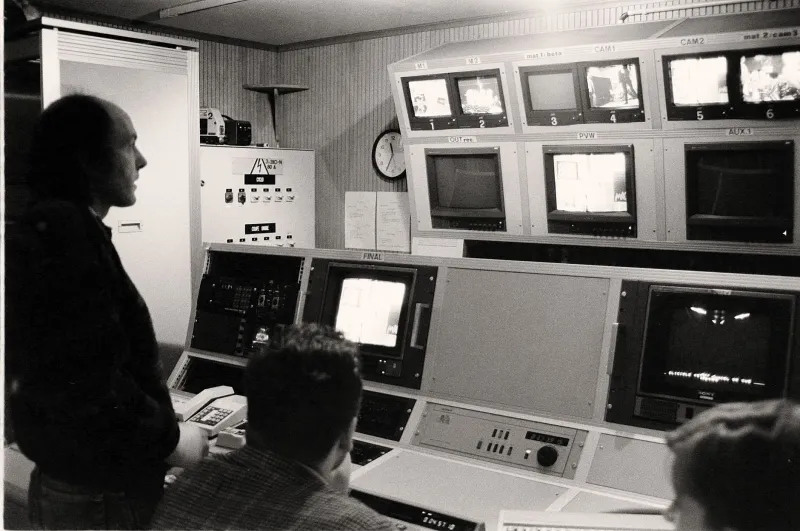
When the Grid Fails, This Signal Holds: The Case for Local TV as Emergency Infrastructure

There is a particular silence that settles over a town when the storm has passed but the information has not. The winds die down. The rain stops. And then the questions begin: Is the water safe? Which roads are open? Where is the cooling center? Is my neighbor's street flooded?
In Princeton, during the worst hours of recent emergencies, the answers have increasingly come from an unlikely source — a community television station operating on a volunteer budget, broadcasting to a town that suddenly needed it more than it ever had before.
The Gap That National Coverage Cannot Fill
It is worth being honest about what happens to media during a crisis. National networks, obligated to cover an entire coast or an entire country, deliver coverage that is accurate but abstract. Social media, the supposed modern solution, becomes exactly what critics feared during Princeton's worst outages: unusable. Cell towers fail. Batteries die. And even when a signal survives, the platforms drown reliable information in rumor, reposts, and outright fabrication.
Local television occupies a different position entirely. It is not abstract. It is not algorithmic. And in Princeton's case, it is powered by people who live on the same streets as their audience.
During a prolonged heat wave two summers ago, when rolling outages left pockets of the town without power or air conditioning, Princeton TV shifted its regular programming and ran continuous updates: which senior centers had backup power, which public buildings remained open overnight, which intersections to avoid. Residents with battery radios — a surprisingly large number, it turns out — reported tuning in precisely because the information matched their actual surroundings.
"The national weather service tells you a storm is coming," says one longtime viewer, a retired municipal engineer. "Princeton TV tells you whether your culvert is going to overflow. Those are not the same thing."
What the Staff Learned
Station staff describe a quiet evolution in their emergency posture. Years ago, severe weather meant simply canceling regular programming. Today, the station maintains a written continuity plan: pre-recorded public safety segments ready to air, agreements with the municipality to relay official notices, and a low-power transmission path that functions even when internet-based distribution fails.
That last point deserves emphasis. Much of modern media depends entirely on the internet — and the internet depends entirely on the grid. A broadcast signal, by contrast, can reach battery radios and television sets running on modest generator power. In an era when every platform wants to be an app, over-the-air broadcasting has quietly become a redundancy worth defending.
The station has also invested in relationships. When emergency management officials know the station's producers by name, information moves faster. When volunteers live in the neighborhoods they cover, they know which assisted-living facilities to check on before anyone asks.
Why Funding Should Follow Function
Here is the uncomfortable arithmetic. Community media stations across the United States operate on budgets that would not cover a single week of a metropolitan newsroom's expenses — and many operate on less. They are routinely treated as charming amenities, cultural garnish, nice-to-haves.
Yet during emergencies, they perform functions that no other institution performs: granular, trustworthy, immediately local information delivered over a signal that works when everything else does not. That is not garnish. That is infrastructure. And infrastructure is something we as a society have traditionally agreed to fund deliberately, not accidentally.
The case for doing so is straightforward. A modest, stable public appropriation — the cost, in most municipalities, of a single intersection improvement — would allow community stations to maintain backup power, harden their transmission paths, and train volunteers in emergency broadcasting protocols. Compare that to the cost of even one preventable casualty in a flood or heat event, and the investment argument makes itself.
A Heritage Worth Extending
There is something fitting about this role. Community broadcasting in America has always carried a civic DNA — the public-access movement was built on the conviction that ordinary citizens deserved a voice in the medium that shaped their communities. Emergencies don't create that purpose; they reveal it.
Princeton's experience offers a lesson for towns everywhere: the time to build local media capacity is before the storm, not during it. The volunteers, the equipment, the relationships, the continuity plans — none of it can be improvised at the moment the sky darkens.
When the next hurricane tracks up the coast, the national feeds will cover it well, in their way. But the questions that matter at 2 a.m. — the ones about this street, this shelter, this neighbor — will be answered locally, or not at all. Princeton has decided they will be answered. Every community deserves the same choice.